
Kid Loot in RPGs
Gamifying
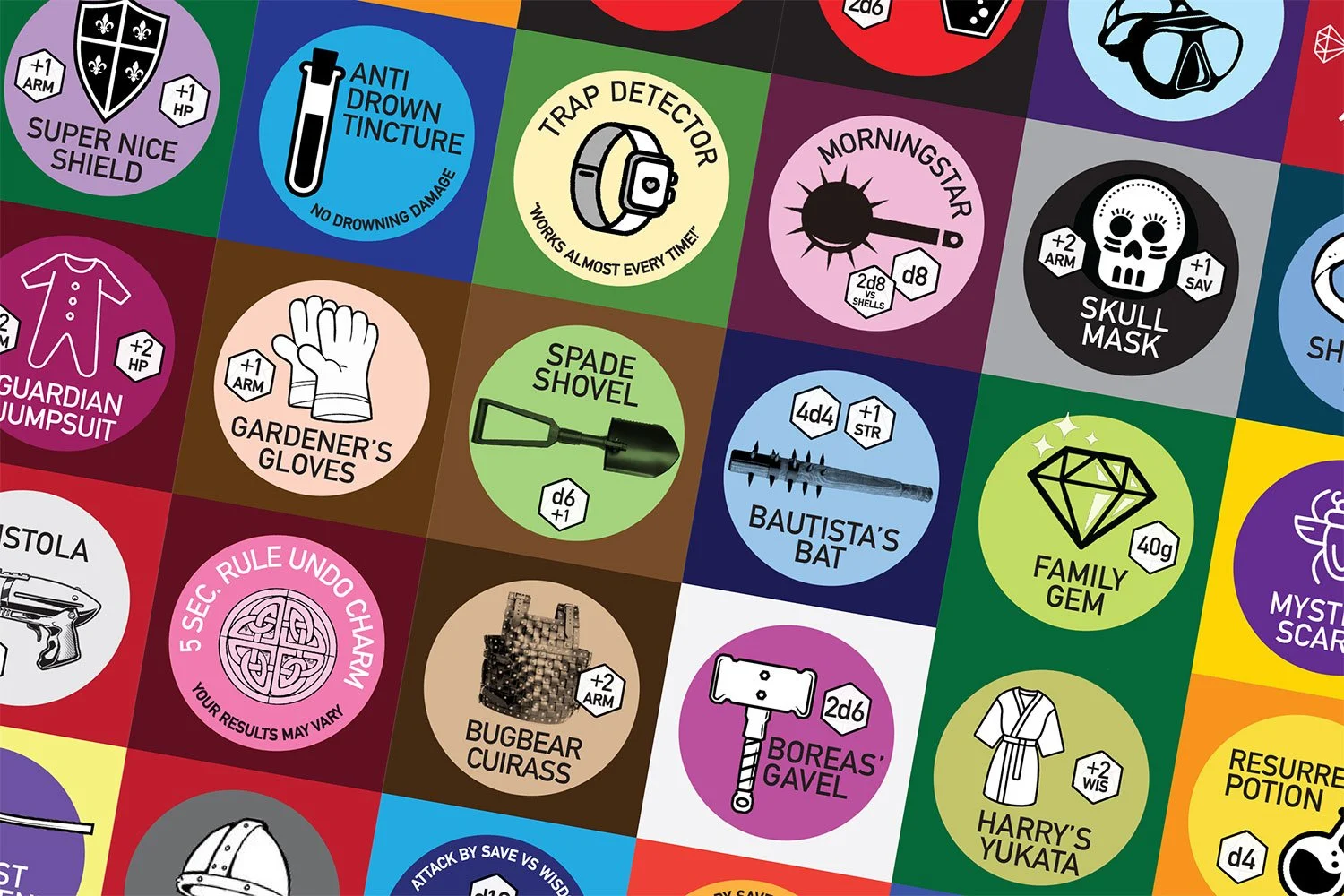
As nerd dads do, we attempted to play D&D with our kids. To our dismay, we were taken aback by confusion, unwilling lack of imagination, and outright boredom coming from the kids. What did we do wrong? The rulebook charts and tables combined with overly-complicated character sheets (that honestly are more like IRS tax forms than vivid portrayals of their personas) were just too overwhelming for grade-school children. Traditional 5e D&D really didn’t jive with our kids. We had to do something about it. Since we three dads have backgrounds in design, art, and education, we put our skills to the test. The first step, to help visualize weapons and armor, was in creating boardgame-esque tokens for each sword, shield, and vambrace. This immediately caught their attention and interest in the game. We were on to something.
Early prototypes for Ampersand RPG Loot Tokens
This lead to storing the tokens in a paper-doll like mannequin, inspired by videogames like World of Warcraft and Zelda. And while we’re at it, why not just make everything a game a token? Ropes, gems and potions. Gold statues, pet food, and puzzle pieces. Everything became a visually-compelling, easy to understand token. After a trial run, we realized it was really effective in engaging the kids and allowed them to take ownership and breathe life into their characters.
And it wasn’t spoon-fed. We ultimately decided to illustrate items in a neutral black & white, iconographic line art. This forces kids to use their imaginations and generate a narrative for each of these objects: create a backstory and history… formulate a visual depiction of what they were like… justify powers and limitations of these items. Synapses were firing!
Loot Tokens tucked into a Player’s Character Folio
Side Effects
While the idea of collecting loot in token form was obviously compelling, we began to see beneficial side effects in gameplay. By tokenizing a Fire Sword +1 in a physical object, as opposed to writing easily-forgotten words on a character sheet, it becomes a real, non-fungible, commodity to use, trade, or sell. This really helps the kids understand its precious value, while encouraging serendipitous, unexpected social interactions that might not have occurred with a forgotten line-item on a sheet. “Hey, you’re a wizard! I’ve been carrying this magic wand token for no reason. You should have it!” That was really great to see.
At first, we tried to categorize equipment with a tags like “For the Feet”. However by physically inserting tokens in specific slots on their paper doll, there was no need for those labels. Plus, it fostered some creative thinking. Why couldn’t you equip a boot in your hand and huck it at a hobgoblin? It not only encourages innovative, unorthodox ideas, but inevitably hilarious and memorable moments that become part of the story. Ridiculous smiles and astonished cries from just equipping a Dutch Oven as a helmet or spontaneously fashioning a Fire-resistant Breastplate from Ice Cube Trays.
Loot Tokens from skirmish Module B2 found in LoadOut issue 1

Another traditional dungeon-crawling side effect that is addressed is encumbrance. Because we didn’t want to create finicky paper or coin-based currency, we have our players tally their gold on their Character Folio. However, if they amass 100g, they have to trade it in to the GM for a 100g Loot Token which has to reside somewhere on their paper doll. If they have no room, they can drop it on the map (to perhaps retrieve later) or give it to a friend. Just as we indirectly enforce the restriction of not being able to carry 10 weapons at once with the paper doll grid, with the token representing a giant bag of coins, encumbrance is somewhat self-managed without the need for the GM to police it. It becomes more of a challenge in gameplay rather than a restrictive rule.
Tokens Over Tables
The tokens also give us a nice format to describe item attributes. We created a visual iconography for these numbers based on their function: Attribute modifiers in rectangles; Health bonuses in a heart; Weapon damage as a die; Gold value in a coin; Can a pet use it? This makes it very easy for players to quickly understand the item benefits without the need for flipping through pages and look-up tables in a manual just to figure out that your Pick Axe damage is 1-4 with a -1 To Hit modifier. Everything you need to know is on the face of the token! We use the backside of the token for more in-depth explanations or just to put down some flavor text. To show item rarity we use a subtle ranking system from one to five dots at the top of the token border. Item rarity creates an extra dimension for players to assess loot value. The Loot Token really covers a variety of game aspects in a tidy form factor.
Anatomy of Loot Tokens from Mages & Macrophages
Buffing a Vampire Slayer
Right now we’re working on a new type of Loot Token called a Loot Ring. The ring is physically overlayed on a target token to indicate its bestowed added benefit. The sandwiched pair slides in together on the paper doll. This represents “buffing” an item where your d2 Wooden Stake becomes a d2+1 Wooden Stake vs Vampires!
We are planning on integrating Loot Rings in our next release of LoadOut zine or the next full adventure ScreenBox game (probably Snakes & Sarcophagi). Make sure to sign-up for the mailing list to get notified on product releases.
Token Gestures
Every Adventure we create includes Loot Tokens for items germane to the story, but the cool thing about them is items can be used in any campaign or story. Unlike traditional RPGs, Ampersand RPG Loot Tokens are physical circles of cardboard. This means we can create non story-related Loot Tokens as independent giveaways and promotions. This has been a tremendous marketing vehicle. They can be simply printed on a postcard which can be cut or printed for player use. Other RPGs can’t effectively do this “offline” character equipment management. We’ve even bundled exclusive Loot Token weapons with their own color-matched damage die.
The system we have developed for loot in Ampersand RPGs has really become the backbone and driving incentive for players in our game. And we wouldn’t have it any other way! The colorful and engaging tokens prominently gridded on a player’s Character Folio allow players to react spontaneously with their full inventory always at hand and ready to go. Loot Tokens have become an instantly recognizable trademark of Ampersand RPG games.
Let us know what you think of Loot Tokens in the comments below!
[ written by a human with no use of AI ]
Ampersand RPG LoadOut zine is bundled with the skirmish adventure “Module B2”. You can play it as-is, but for the best gameplay experience, pair it up with a ScreenBox.